
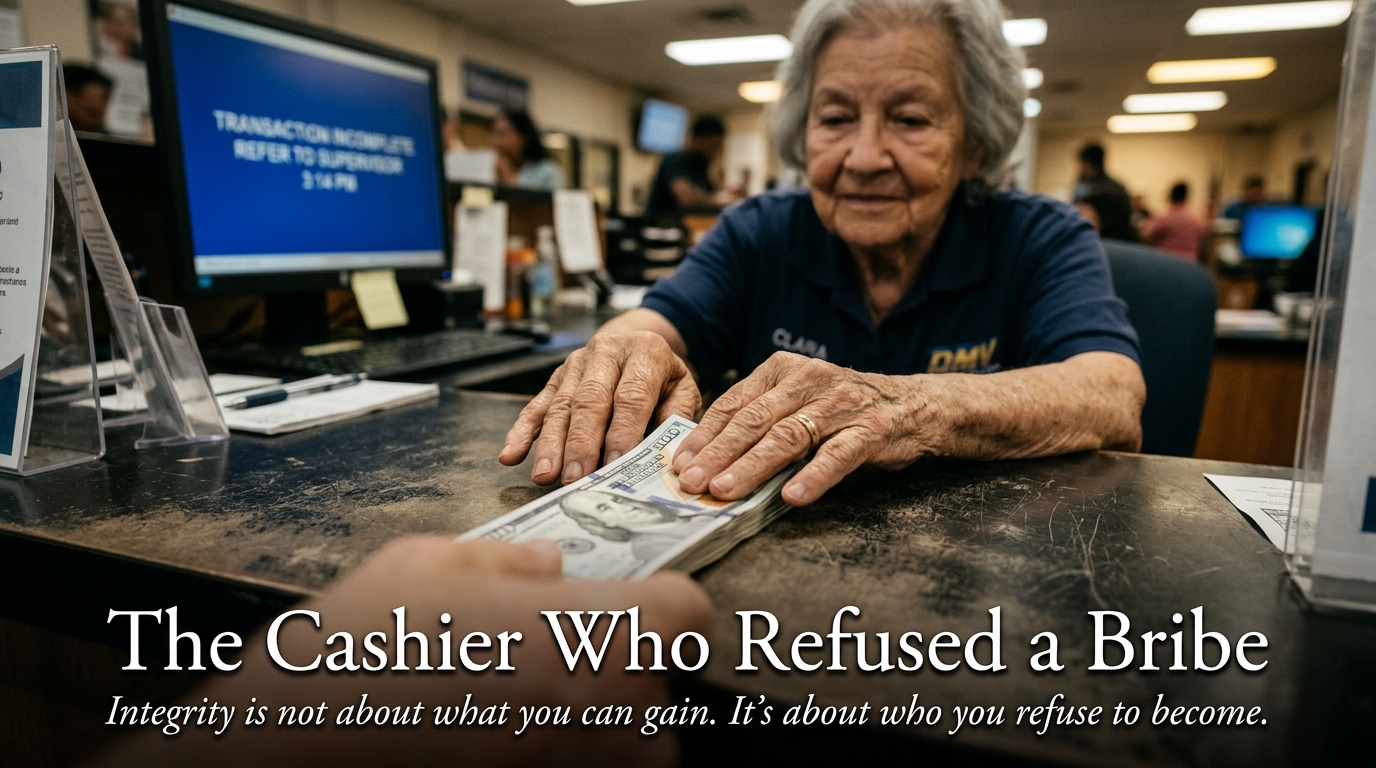
The fluorescent light in the DMV flickered, casting a sickly green pallor on the linoleum floor and the weary faces of the people waiting. The air smelled of wet wool coats and stale coffee. It was 4:45 PM on a Friday, and Clara Morrison was counting the minutes, not out of laziness, but out of a deep, bone-tired ache in her lower back. She had been standing at the counter, processing registrations and title transfers, for seven hours.
Clara was sixty-seven years old. Her silver hair was pulled back in a bun so tight it seemed to pull the wrinkles out of her forehead. She was a widow, a grandmother of four, and she’d taken this job three years ago not for a second act of ambition, but because her pension didn’t quite cover the cost of the good heart medicine her husband, Frank, used to take. She knew the cost of things. She knew the value of things more.
At 4:58 PM, a man burst through the front doors. He wasn’t just walking; he was moving with the frantic energy of a man trying to outrun a disaster. He wore an expensive, navy-blue suit that was wrinkled at the elbows, and his tie was yanked loose. He bypassed the “Take a Number” machine and made a beeline for Clara’s Station 4.
“Please,” he gasped, slapping a thick manila folder on the counter. “I need to register this transfer. It has to be done today. Right now.”
Clara looked at him over the top of her bifocals. She saw the sweat beading on his forehead despite the cold outside, and the raw panic in his eyes. It was a look she recognized. It was the same look Frank had when they told him the test results. It was fear.
“Sir, we’re closing in two minutes,” Clara said, her voice soft but firm, like a worn leather glove. “The computer system cycles at five. I can’t process a new title after that, it locks me out. You’ll have to come back Monday morning.”
“Monday is too late,” he said, his voice cracking. He was younger than she’d first thought, maybe early forties, but the stress had carved hollows under his cheekbones. “I know the system. I know you can override it if you want to.”
Clara raised an eyebrow. “Override it? Honey, I can’t even override the font size on this screen without calling IT in Topeka.”
The man leaned in closer, lowering his voice. “Look, my name is Arthur Vance. I’m a developer. This property,” he tapped the folder, “is the key to a whole new downtown project. If this title isn’t in my company’s name by midnight, the financing falls through. I lose everything. My investors. My house. My kid’s college fund.”
Clara’s heart, that old, reliable muscle that had weathered so much grief, gave a sympathetic squeeze. She knew about losing everything. She remembered the quiet afternoons after Frank’s funeral, boxing up a life that no longer fit.
But she also knew the rules. The rules weren’t just about bureaucracy; they were about fairness. If she bent them for Mr. Vance in the nice suit, she’d be spitting in the face of the single mother who had been there at 7:00 AM with a screaming toddler, waiting for her number to be called.
“I’m sorry, Mr. Vance. Truly, I am. But the system is the system. Monday.”
That’s when he did it. Arthur Vance reached into his suit jacket and pulled out a money clip. Not the cheap kind. Gold. He peeled off ten crisp, new hundred-dollar bills. He slid them under the edge of the manila folder so the cameras in the ceiling corners wouldn’t see the direct exchange, but Clara could feel the paper’s edge against her knuckles.
“One thousand dollars,” he whispered. “Just click the mouse. Override the lockout. Just this once. Please, Clara.” He had read her nameplate. “It’s a victimless crime.”
Clara stared down at the money. One thousand dollars. That was almost two weeks of her salary after taxes. That was the co-pay for three months of her blood pressure medication. That was a new set of tires for her old Buick so she could drive to see her grandson’s Little League games without the car shaking.
For a long, terrible second, she imagined it. She imagined the relief of the extra cash. She imagined not having to choose between the electric bill and the grocery store.
But then she looked at the money again, and it didn’t look like relief. It looked like a weight. It looked like a chain.
She looked up at Arthur Vance. He was waiting, his hand trembling slightly on the counter.
“Mr. Vance,” Clara said, her voice dropping so low he had to lean in to hear. “Do you know why I work here?”
He shook his head, confused.
“I worked at the public library for thirty-two years before this,” she continued. “I shelved books. I helped kids find stories. I showed seniors how to use the internet to email their grandchildren. I loved that job. But I left because the budget cuts meant they stopped buying new books. I came here because it was a steady check, and because my husband Frank always said, ‘Clara, you’re the most honest person I know. The world needs more of you.’”
She picked up the stack of hundreds, holding them between her thumb and forefinger as if they were a dead mouse. She did not put them back on his side of the counter. She held them up in the air, just below the level of the counter, so only he could see.
“I am sixty-seven years old, Mr. Vance. I have nothing in this world that can’t be taken away except my name. And my name is Clara Morrison. And Clara Morrison doesn’t take bribes. Not for a thousand dollars. Not for a million. Because if I take this, the system isn’t the only thing that’s broken. I’m broken.”
She slid the money firmly back across the counter, under his hand.
He looked devastated. His shoulders slumped. The fear in his eyes was replaced by a hollow, cavernous shame. He looked at the floor.
“I’m sorry,” he mumbled, his voice thick with humiliation. “I’m… I’m not this guy. I’m not.”
“I know you’re not,” Clara said gently. The edge was gone from her voice. It was just kindness now. “You’re just a man who’s scared. We all get scared.”
He nodded, his jaw clenching. He turned to leave, a man walking to the gallows of a failed weekend.
“Wait,” Clara called out.
Arthur stopped.
“Give me the folder.”
He turned back, hope and confusion warring on his face. “But… you said the system locks at five.”
“It does,” Clara said, pulling the folder toward her. “It locks for new registrations. It won’t issue a new title today. But I can process a preliminary filing. It’s a placeholder. It time-stamps your intent and holds the VIN number in escrow for seventy-two hours. It’s not a full title, but any judge in this county will recognize it as a good-faith effort to beat the deadline. The bank can’t deny you based on a technicality if you have a filed time-stamp from a state office.”
Arthur blinked. “You can do that?”
“It’s not an override,” Clara said, her fingers flying over the grimy keyboard with the speed of a woman who had typed thousands of library catalog cards. “It’s just knowing how the machine really works. It takes ten seconds. And it doesn’t cost a thousand dollars. It just costs a little patience.”
She typed, stamped, and signed a blue form. She handed it to him. The clock on the wall said 5:01 PM.
“There,” she said. “You’ll sleep better tonight. And so will I.”
Arthur Vance held the paper like it was a winning lottery ticket, which, in a way, it was. Tears welled in his eyes. “I don’t know how to thank you.”
“You already did,” Clara said, reaching for her coat and her sensible purse. “You showed me that you could be better. And you reminded me why Frank was right about me. Now go home. Hug your kid.”
As Clara walked out into the cold evening, she felt the ache in her back and the chill in the air. But she also felt something else—a warmth that had nothing to do with the heating vents. It was the quiet, solid hum of integrity. She hadn’t taken the thousand dollars, but she had walked away with something worth far more. She had kept herself whole.


Leave a Reply