
The sign on the truck door read: Torres & Son Construction. Est. 1987. But the “& Son” part was just a memory now. Leo Torres, sixty-three with hands like gnarled oak roots, drove the truck alone. His son, Miguel, was in a crisp office downtown, wearing a tie and pushing numbers around a screen. “More stable, Dad,” Miguel had said. Leo didn’t argue. The work was in the bones, not in the office.
That’s why he almost said no to the house on Primrose Lane.
The call came from a woman named Eleanor Vance. Her voice was the kind of sound old lace makes when you unfold it—soft, fragile, and holding a tremble. The job was a screened-in back porch, rotting off its foundation. “I saved for two years,” she told Leo over the phone. “The estimate from the big company was… well, it was more than my house cost in 1972.”
Leo went to see it. The house was a small Cape Cod with a garden that had the tired look of a well-loved, but fading, painting. Eleanor met him at the door. She was eighty-seven, with bright blue eyes and a spine curved like a question mark. She offered him lemonade before he’d even measured a board.
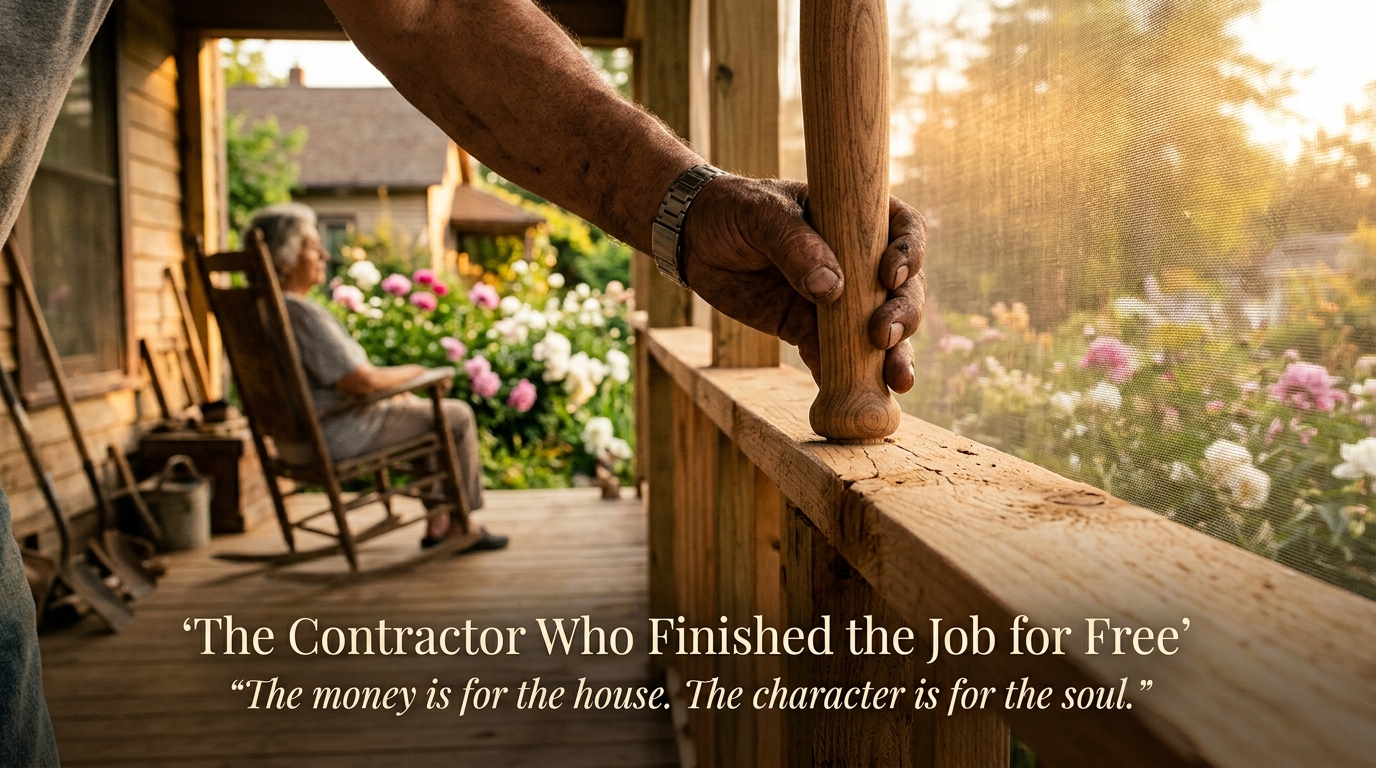
The porch was a mess. The sill plate was dust, the joists were sagging like tired hammocks, and the screen door screamed like a wounded cat. But as Leo walked the perimeter, he noticed things a lesser contractor wouldn’t. He noticed the way the afternoon light hit the overgrown peonies just outside the screen. He noticed the single, worn-out rocking chair facing west.
“My Harold built it,” Eleanor said, reading his mind. “In ’58. He said a woman needed a place to watch the world go by without the bugs joining her for supper. He’s been gone twenty years this June.”
Leo wrote up the estimate. It was fair. Tight, but fair. $4,200 for materials and labor. Eleanor didn’t blink. She went to her china cabinet and came back with a check. The handwriting was shaky but the numbers were clear.
“Are you sure you don’t need this for something else?” Leo asked, looking at the worn carpet and the single lightbulb in the kitchen fixture. It was a contractor’s question, but also a human one.
“Mr. Torres,” she said, “I don’t buy green bananas anymore. I want to sit on my porch.”
They shook hands. Her skin felt like rice paper.
The first week of demolition revealed the truth. And the truth was ugly. Leo pulled up the first three deck boards and found not just rot, but a colony of carpenter ants that had been dining on the heart of the structure for decades. He checked the ledger board attached to the house. His heart sank. It wasn’t just rotted; the flashing had failed years ago, allowing water to seep into the house’s rim joist. The rot had spread from the porch into the main structure of the house.
This wasn’t a $4,200 repair. This was a structural crisis. If he didn’t fix the rim joist and the subfloor inside the wall, the back wall of Eleanor’s house would start sagging within two more winters. A new estimate from a big firm would be north of $15,000, maybe $20,000 with lumber prices.
Leo sat on the tailgate of his truck for a long time that evening. He watched the sun set in the same spot Eleanor liked to rock. He thought about the check in his glove box. $4,200. He thought about the “& Son” on his truck door. He thought about his father, the original Torres, who had started the business in ’87 with a hammer and a handshake. His father had a saying: “The money is for the house, Leo. The character is for the soul.”
Leo didn’t have a son to teach that to anymore. But he had this job.
The next morning, he didn’t call Eleanor to renegotiate. He didn’t tell her about the rim joist or the ants or the terror of a collapsing wall. He just started working longer hours. He called in a favor from a drywall guy he’d bailed out of a jam in ’05. He used the premium-grade, rot-resistant lumber he’d been saving for his own deck project. When Eleanor asked why the pile of lumber in the driveway had doubled in size, Leo just smiled and said, “The yard had a two-for-one sale.”
For three weeks, Leo Torres did the work of three men. He jacked up the back of the house, inch by painstaking inch, and replaced the rotten bones of the structure. He built a new porch floor so solid you could park a truck on it. He rebuilt the screens with tight, flawless joints. He even found a salvaged piece of pine with a knot that looked exactly like the one on the original railing Harold had built in ’58. He sanded it smooth and put it right where Eleanor’s hand would rest when she walked out.
He finished on a Thursday afternoon. The sun was perfect. He swept the new deck, moved Eleanor’s old rocking chair into place, and fixed the squeak on the new screen door so it closed with a whisper instead of a shriek.
Eleanor came out. She didn’t say anything for a full minute. She just looked at the fresh wood, the tight corners, and the peonies that Leo had carefully staked up so they wouldn’t get trampled. Then she looked at the railing. She saw the knot. She touched it.
“This is Harold’s porch,” she whispered, her voice cracking. “It just smells newer.”
Then came the hard part. The accounting. Eleanor brought out her checkbook again. “Leo, I saw the lumber truck. I may be old, but I’m not blind. The pile was twice as high. Let me write you another check. I can do $2,000 more from the emergency fund.”
Leo took her hand and gently folded it closed over the checkbook. His hands, rough enough to sand wood without paper, were infinitely gentle.
“The price was the price, Miss Eleanor,” he said. “You paid for a porch. You got a porch. The rest of it was just… ensuring it stayed a porch.”
He wouldn’t take a dime more. He packed his tools. As he was loading the last saw into the truck, Eleanor called him back. She was holding a small paper bag.
“Not money,” she said firmly. “It’s a pie. Rhubarb. From Harold’s mother’s recipe. I can’t eat a whole pie by myself.”
Leo took the pie. That night, he sat alone at his kitchen table. He cut a slice. It was tart and sweet, and the crust was perfect. He ate the whole thing over three days. It was the best payment he’d ever received.
A month later, a letter arrived at his office. It was from Eleanor’s daughter in Ohio. It read:
“Dear Mr. Torres, Mom passed last night. Peacefully. In her rocking chair on the porch. She had her tea and was watching the fireflies come up over the peonies. The last thing she said to me on the phone was, ‘There’s still a good man in the world, and his name is Leo.’ Thank you for giving her back her view.”
Leo pinned the letter to the corkboard next to his father’s old license. He looked at the truck keys. He didn’t feel like a man working alone anymore. He felt like a man who had finished the job. For free. For everything.



Leave a Reply