
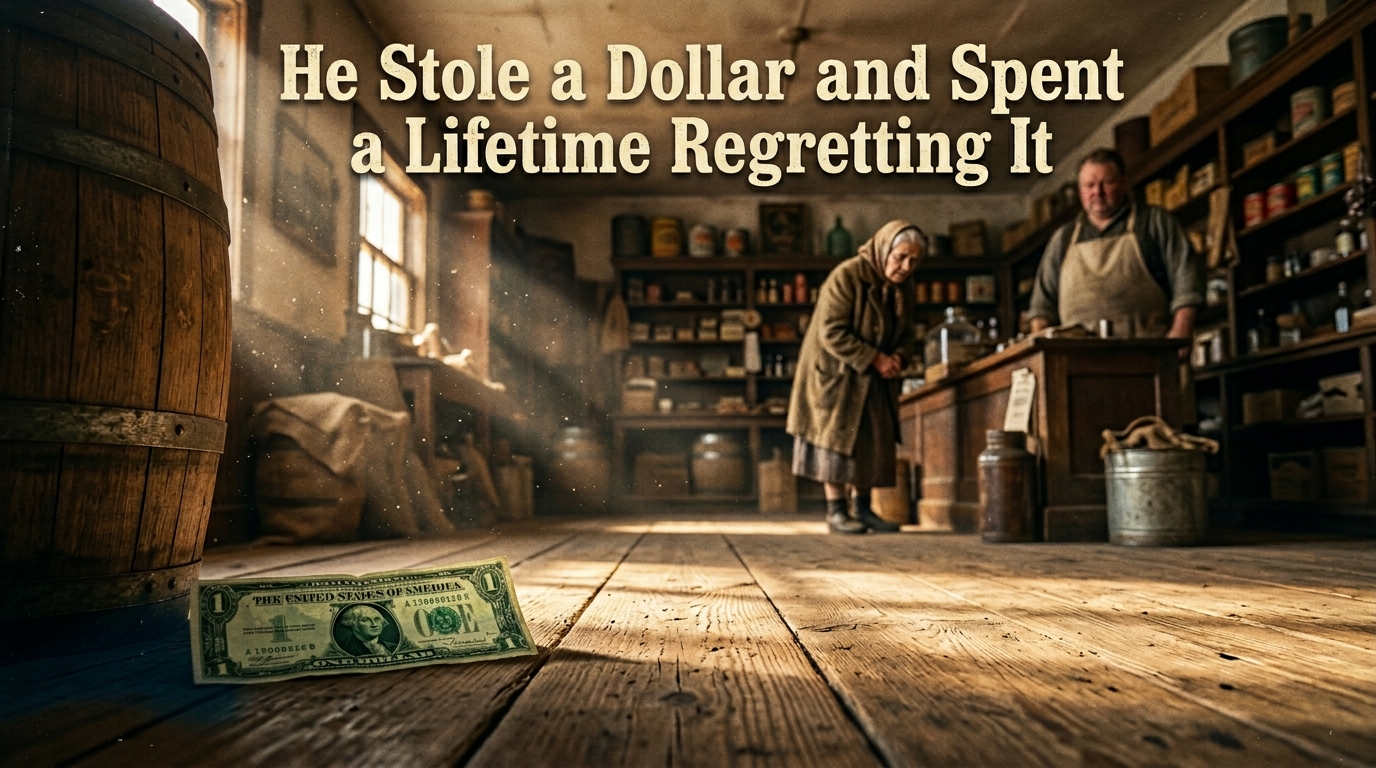
The morning sun slanted through the dusty window of Miller’s General Store, illuminating motes of flour dust that hung in the air like tiny, forgotten stars. Arthur P. Hendricks, aged twelve and wiry as a fence post, stood before the glass counter, his nose nearly pressed against the display. Inside, gleaming under the brass cash register’s shadow, was a pyramid of red licorice whips.
Arthur’s pocket was a hollow cave. The Great Depression had not just emptied bank vaults; it had vacuumed the joy right out of a boy’s Sunday. He watched as Tommy Albright, the banker’s son, sauntered in, slapped a nickel on the counter, and walked out with a sack of horehound drops without a care in the world.
As Arthur turned to leave, his worn-out boot scuffed against the wide pine floorboards. That’s when he saw it. Wadded up, half under the pickle barrel, green as spring grass and crisp as a new leaf. A dollar bill.
His heart hammered a woodpecker’s rhythm against his ribs. A dollar. A dollar. In 1934, a dollar was a pair of new socks, four loaves of bread, or a hundred of those red licorice whips staring at him with their sugary, mocking eyes.
He didn’t think. His hand shot out like a striking snake, snatching the bill and stuffing it deep into the pocket where coins never resided. He turned to bolt for the door, but his path was blocked by the vast, aproned form of Mr. Jenkins, the store owner.
“Find somethin’ you like, Arthur?” Mr. Jenkins asked, wiping his hands on a rag.
“No, sir. Just lookin’.” Arthur’s voice was a squeak. He could feel the dollar burning a hole through his thigh, a green flame of guilt.
As he slipped past the counter, he heard a frantic rustling near the flour sacks. Old Mrs. Crabtree, her hands gnarled by arthritis and decades of taking in laundry, was patting her worn coat pockets. Her face was the color of old dishwater. “Oh, mercy,” she whispered to Mr. Jenkins, her voice cracking like thin ice. “I had it right here. I had a dollar folded up for Henry’s cough syrup. I must have dropped it. Oh, dear Lord, I can’t find it.”
Mr. Jenkins helped her look. He even got down on his creaking knees to peer under the pickle barrel. Arthur stood frozen by the door, the brass bell above him jingling faintly in the draft.
Henry’s cough syrup.
Henry was her grandson. Arthur knew him. He was a frail boy, three years younger, with a cough that rattled deep in his chest like a pebble in a tin can.
Arthur’s hand clenched around the bill in his pocket. She’ll never know. Finders keepers. It’s just a dollar. She probably has another one at home.
But he knew she didn’t. He knew because his own mother darned socks by candlelight until her fingers bled. He knew because a dollar in this town wasn’t paper; it was time. It was hours bent over a washboard.
The words of apology, the simple act of pulling out the bill and saying, “I found it, ma’am,” stuck in his throat like a wad of dry cotton. He was terrified. Terrified of Mr. Jenkins’ stern look. Terrified of being called a thief in front of Tommy Albright. Terrified of the shame his mother would feel.
So, Arthur did the easiest thing. He pushed open the door and ran. He ran past the barbershop, past the schoolyard, until he reached the hollowed-out sycamore tree by the creek. There, hidden from the world, he unclenched his fist. The bill was damp with his sweat. He bought the licorice the next day at a store two towns over, eating it alone under the bridge. It tasted like ash and glue.
He never told a soul.
Fifty years passed like a freight train. Arthur P. Hendricks was now a grandfather himself, the CEO of a modestly successful construction firm. He was known around town as an honest man—”Straight as a level,” they’d say. He donated to the church roof fund and never padded an invoice. His integrity was the cornerstone of his reputation.
But that reputation was a lie, and only Arthur knew it. Every time someone shook his hand and said, “You’re a good man, Art,” a phantom green light flickered in the corner of his eye. Every time he saw a red licorice whip in a candy aisle, his stomach turned sour.
He had tried to bury the memory under a mountain of good deeds. He had shoveled Mrs. Crabtree’s walkway the winter after he stole her dollar, hoping she wouldn’t recognize him in the snow. He had left an anonymous envelope with ten dollars in her mailbox years later, signed “Repayment.” But the weight never lifted. The dollar wasn’t just a debt of currency; it was a debt of character.
On his sixty-second birthday, Arthur found himself standing outside the county nursing home. Inside, frail and wispy as a dandelion gone to seed, was Henry Crabtree. Henry had never fully recovered from those childhood bouts of sickness. He had lived a hard, quiet life, never venturing far from the county line.
Arthur walked in, clutching a tin of hard candies. Henry was in a wheelchair by the window, looking out at the same sycamore trees Arthur had hidden in.
“Henry? It’s… it’s Arthur Hendricks.”
Henry squinted. “The builder? Sure, I know you. You’re the fella who fixed the ramp out front last spring. Didn’t charge a dime. Good man.”
Arthur flinched. “No, Henry. I’m not a good man.”
He sat down, his bones aching with a pain that had nothing to do with age. And there, in the antiseptic quiet of the room, Arthur told him. He told him about the dusty floor, the green bill, the pickle barrel, and the sound of his grandmother’s desperate voice. He told him about the licorice that tasted like guilt and the fifty years of looking over his shoulder for a ghost he could never outrun.
“I stole a dollar from your grandmother,” Arthur said, his voice thick with tears he’d held back for half a century. “And I’ve been trying to pay it back my whole life, but the interest on a sin against the helpless just keeps compounding.”
Henry didn’t speak for a long time. He just looked at Arthur with those rheumy eyes. When he finally spoke, his voice was a whisper of dry leaves.
“My grandma never forgot that dollar,” Henry said. “Not because she was angry. But because she cried that night. She cried not for the money, but because she thought she was getting so old she was losing her mind, dropping things and forgetting where she put ’em. She died thinking she was a burden to me because she couldn’t hold onto a scrap of paper.”
Arthur wept. He wept for the boy he was and the man he pretended to be.
“I’m so sorry.”
Henry reached out a hand, the veins blue and visible under paper-thin skin. He patted Arthur’s hand.
“I forgive you,” Henry said. “But I think, maybe, you needed to hear me say that so you could finally forgive yourself.”
Arthur left the nursing home an hour later. He walked back to the site of the old Miller’s General Store, now a parking lot. He knelt on the hot asphalt and put a single, new, crisp dollar bill on the ground. He held it there for a moment with a rock, just like Mrs. Crabtree had done fifty years ago, and then he let it go. The wind caught it, sending it skittering toward the curb.
But this time, Arthur didn’t chase it. He had finally learned the cost of a stolen moment. It wasn’t a dollar. It was a lifetime of looking in the mirror and seeing a boy with licorice in his pocket and a lie in his heart.
He stood up, the weight of decades finally lighter than a feather. He had spent a lifetime paying for a theft of a single dollar, and the only currency the debt accepted was his own integrity. The bill was paid in full.


Leave a Reply