
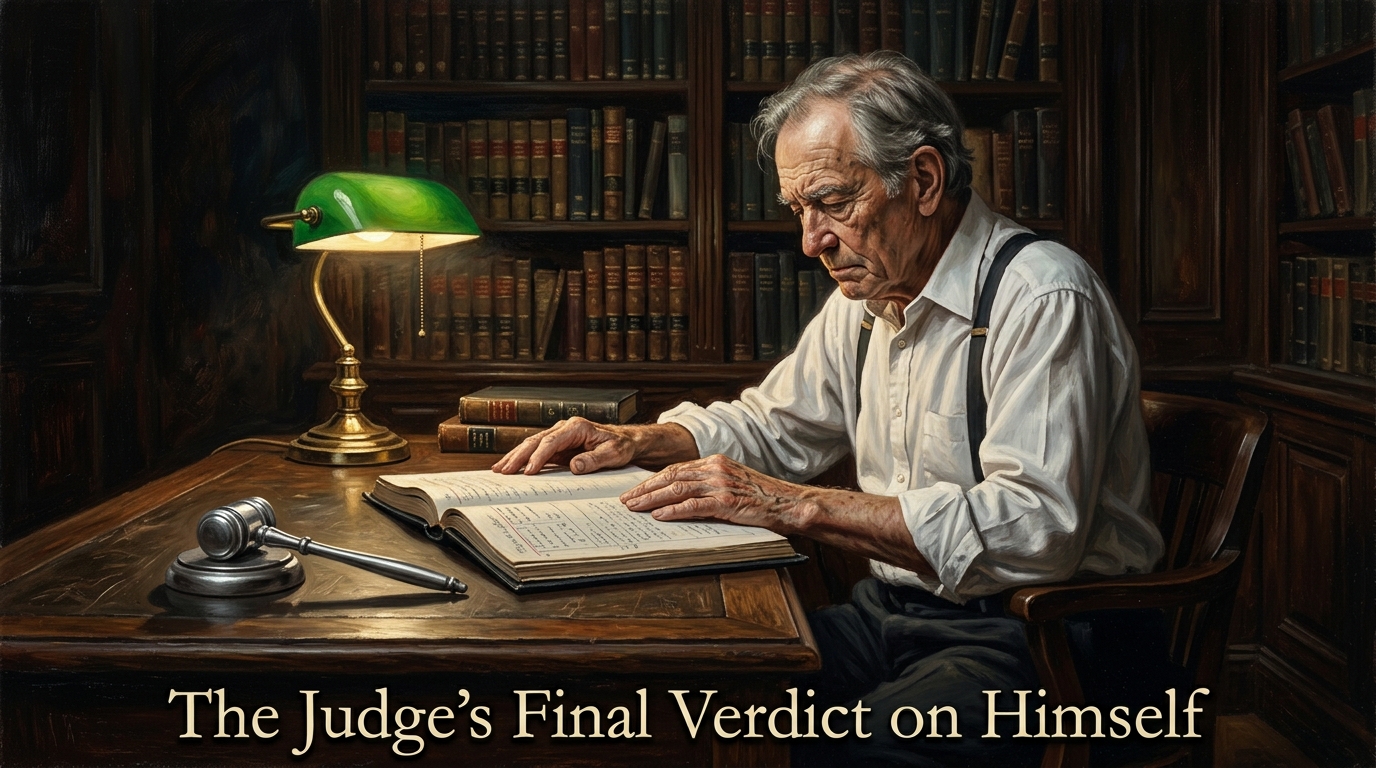
For forty-two years, Judge Theodore Whitfield had sat upon the mahogany bench of the Third District Court, a place where the air smelled of old paper, floor wax, and the heavy weight of consequence. He was known as “The Hammer”—not for gavel theatrics, but for the unyielding, precise, and immovable nature of his rulings. He was respected, feared perhaps, but rarely loved. He didn’t mind. The law, he often told his clerks, was not a valentine; it was a scalpel.
At seventy-four, arthritis had turned his once-steady hand into a gnarled root, and the cataracts clouding his eyes made the fine print of legal briefs swim like minnows. Retirement was not a choice; it was a medical directive. On his final day, the courthouse staff held a small reception in the rotunda. There was polite clapping, a sheet cake with white frosting, and a plaque that read: “For Unwavering Service to Justice.”
Theodore accepted it with a curt nod, gave a five-word speech (“The law does not rest.”), and walked out into the rain without an umbrella. He wasn’t going home. He had one final piece of business to attend to, a case he had been drafting in his own mind for the last decade.
He went to the only place he felt he could be truly impartial: his study. It was a room lined with leather-bound volumes of case law, but tonight, he wasn’t looking at the spines. He locked the door, sat in his worn green wingback chair, and opened a brand-new, stark-black ledger. At the top of the first page, he wrote in a shaky but deliberate cursive: The People vs. Theodore Whitfield.
He intended to be the prosecution, the defense, and, finally, the judge.
The prosecution went first. It was an easy case to make. Theodore listed the evidence of a life spent in rigid, clinical detachment.
Exhibit A: The case of Morris vs. City Transit. A man was late on a filing by eleven minutes because his car broke down on the bridge while his wife was in labor. Theodore dismissed the case with prejudice. Justice was swift. It was also heartless.
Exhibit B: He had not spoken to his younger brother, Samuel, in nineteen years. The argument? A petty dispute over a survey line of inherited land—an argument Theodore had won on a legal technicality. He had the deed. He had the law. He lost the brother.
Exhibit C: The thousands of faces that blurred before him over the years. He saw them not as humans with broken stories, but as moving parts in a broken machine he was tasked with fixing. He had treated mercy as a flaw in the system’s architecture. He had prided himself on being a “good judge” by the metrics of appeals won, but what about the metrics of the soul?
For an hour, the prosecution in his head was relentless. You were not a judge of character, Theodore. You were a clerk of the law. You measured out punishment by the ounce, but you withheld the pound of grace.
Then, the defense rose. It was quieter, more tired, but stubborn.
Your Honor, the defense whispered, the man sought order in a chaotic world. He saw too many guilty walk free on charm and tears. He built walls around his heart because he had to look at the worst of humanity every single day and not fall into the abyss with them. He paid his taxes. He never accepted a bribe. He was impartial to a fault, yes, but never corrupt. Is that not a form of integrity?
The defense pointed to the hidden drawer in the desk. In it were receipts. Every Christmas, for thirty years, an anonymous donation of exactly five hundred dollars—always cash, always in a blank envelope—was sent to the County Children’s Home. No one knew it was him. He had ensured the clerk kept it off the record. He did not want applause, the defense argued. He wanted to correct a balance sheet only he could see.
Finally, the defense rested on one small, almost forgotten memory. Years ago, a young single mother had stolen baby formula from a bodega. The law was clear: theft, third degree. But the prosecutor was new and asked for leniency. The bailiff expected “The Hammer” to drop. Instead, Theodore had looked down at the woman’s shaking hands and the infant sleeping in the gallery’s back row. He had wiped his glasses, cleared his throat, and said, “Time served. Go home. The court finds that the cost of prosecuting this matter is penalty enough.” He had never told anyone why he did it. It was the only time he had ever overruled his own rulebook.
The study fell silent except for the ticking of the mantle clock.
Theodore Whitfield closed his eyes. He had to render a verdict on himself. Not for a crime, but for a life. He thought of Samuel, his brother, alive just three towns over but as far away as the moon. He thought of the plaque in the courthouse rotunda that would gather dust. He thought of the children’s home where the matron never knew who the Christmas angel was.
He opened his eyes. He picked up the pen. It felt heavier than any gavel he’d ever swung.
He wrote the final judgment in the ledger:
“The court has considered the evidence of a life lived in strict adherence to the letter of the law, but often in violation of its spirit. The defendant is found guilty of willful isolation and pride disguised as principle.
However, the court also recognizes a lifetime of unspoken, anonymous compassion. The defendant did not know how to be kind in the light, but he was kind in the dark.
In the interest of a justice higher than any statute—the justice of the human heart—this court suspends all remaining sentences of loneliness and regret.
Condition of Probation: The Defendant, Theodore Whitfield, is hereby ordered to drive to 227 Maple Street tomorrow morning and ring the doorbell. He is to apologize to his brother, Samuel, not for the survey line, but for nineteen years of silence. The law is served. Now, let the healing begin.
So Ordered.“
Theodore set the pen down. His hands were no longer shaking. For the first time in decades, they were still.
He picked up the phone. It rang three times.
“Sam?” Theodore said, his voice cracking like thin ice. “It’s Teddy. I… I don’t want to be right anymore. I just want to come home.”


Leave a Reply