
He Returned a Wallet and Gained a Father
Leo Martinez was seventeen, the kind of quiet teenager who held doors open without expecting a thank-you and picked up litter on the school track when no one was watching. He lived with his mother in a small apartment above a laundromat. His father had left when he was four, and the only memory Leo had of him was the smell of cheap coffee and the sound of a car door slamming shut.
Money was tight. Leo worked after school at a corner deli, sweeping floors and stacking cans of beans. He didn’t complain. His mother worked double shifts as a nurse’s aide, and Leo had learned early that the world didn’t owe him anything. But he also believed—deeply, quietly—that small acts of goodness were never wasted.
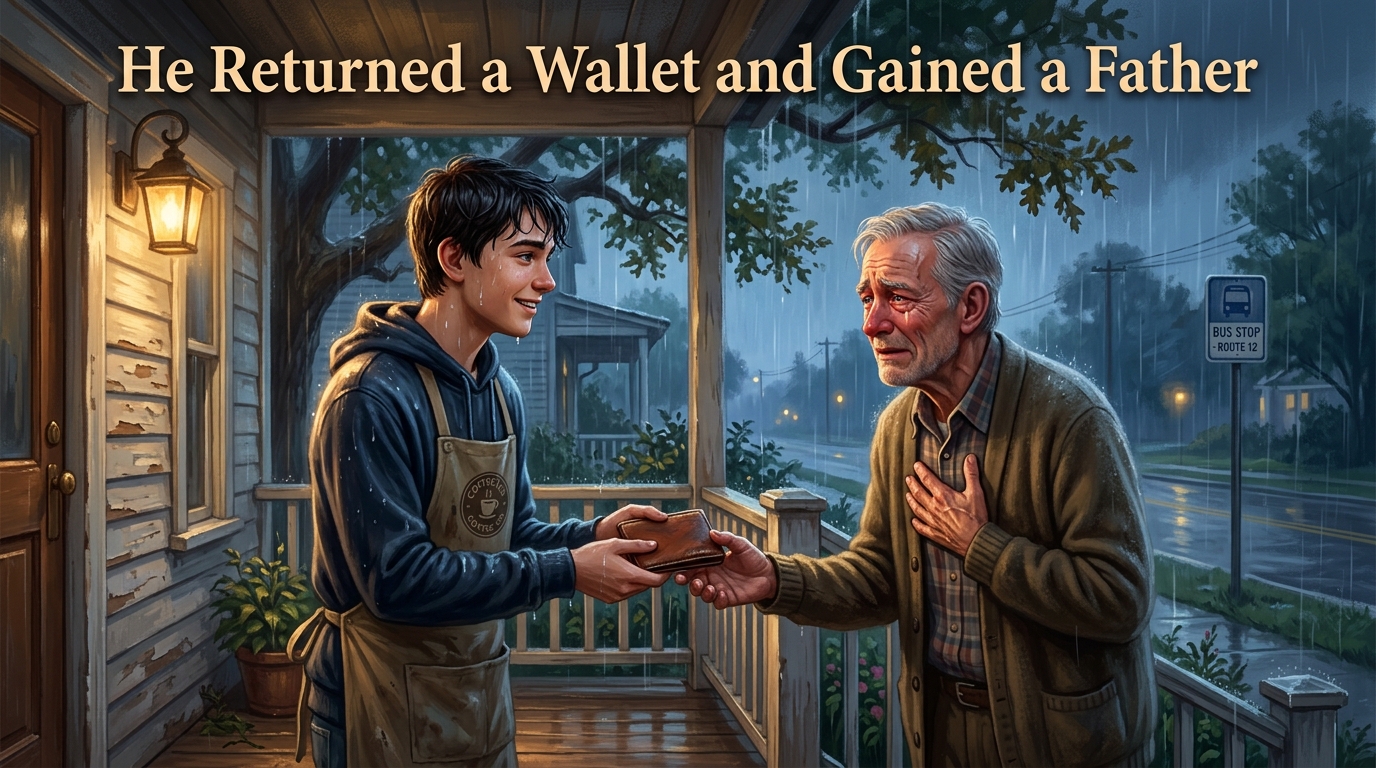
One rainy Tuesday in November, Leo was taking out the deli’s trash when he saw it: a worn brown leather wallet lying facedown in a puddle near the bus stop. He picked it up, wiped it on his apron, and opened it.
Inside were three hundred dollars in cash, a bus pass, a faded photo of a woman holding a baby, and a driver’s license. The name read: Arthur P. Hollingsworth. The address was across town, in a neighborhood of big old houses with porches and oak trees.
Leo’s first thought was not of the money—though three hundred dollars would have paid for his mother’s blood pressure medication and left enough for groceries. His first thought was of the man in the license photo: gray-haired, tired eyes, a face that looked like it had known grief.
“He’s going to miss this,” Leo whispered to himself.
He finished his shift, then walked two miles in the cold rain to the address on the license. By the time he arrived, his sneakers were soaked and his fingers were numb.
He knocked.
The door opened a crack, then wider. Arthur Hollingsworth was a large man with stooped shoulders and the same tired eyes from the photo. He looked at Leo—soaked, shivering, holding the wallet out like an offering—and his face crumbled.
“You found it,” Arthur said, his voice cracking.
“Yes, sir,” Leo said. “I think you dropped it at the bus stop.”
Arthur took the wallet with trembling hands. He opened it, saw the cash untouched, the photo still tucked inside, and suddenly he was crying. Not the quiet kind of crying. The kind that comes from a deep, broken place.
Leo didn’t know what to do. So he just stood there, rain dripping off his chin, and said, “I’m sorry, sir. I hope nothing important was lost.”
Arthur looked up. “Son,” he said, “that photo is my late wife and our daughter. She died ten years ago. Leukemia. This wallet fell out of my pocket the day I was going to spread her ashes at the park. I thought I’d lost her face forever.”
Leo swallowed hard. “No, sir. Her face is safe.”
Arthur invited him in. Made him hot chocolate. Asked his name. Asked about his life. Leo answered honestly—about the deli job, his mother working double shifts, the apartment above the laundromat. He didn’t complain. He just stated facts, like they were weather reports.
Arthur listened. Then he said something Leo never forgot: “You returned a stranger’s entire world without taking a single thing for yourself. That’s not honesty, Leo. That’s holiness.”
Over the next few weeks, Arthur started showing up at the deli. Not for food—for Leo. He brought him sandwiches, then books. He helped Leo with his math homework. He came to his school play. He fixed the leaky faucet in the apartment above the laundromat.
One night, Arthur took Leo and his mother to dinner. Halfway through the meal, he set down his fork and looked at Leo’s mother, Elena.
“I have no family left,” Arthur said quietly. “But this boy—he gave me back my wife’s face. And he gave me back my faith in people. I know I can’t replace the father who left. But if you’ll let me, I’d like to be something close.”
Elena wept. Leo, who rarely cried, felt hot tears roll down his cheeks.
Arthur never legally adopted Leo. But he taught him to drive. He showed up at every graduation. He gave a speech at Leo’s wedding, saying, “The day my wallet was returned, I thought I had lost everything. Instead, I gained a son.”
Years later, when Arthur was old and frail, Leo moved him into his home. He fed him soup. He held his hand. And on Arthur’s last night, Leo whispered, “You didn’t replace anyone, Dad. You became the first real father I ever knew.”
Arthur smiled. And then he was gone.
But Leo kept the worn brown leather wallet in a drawer by his bed. Not because of the money it once held. But because it reminded him that the smallest act of integrity—returning what isn’t yours—can return to you something far greater than you ever lost.
Life Lesson: Integrity is not about what you gain, but about who you become. And sometimes, when you give back what doesn’t belong to you, the universe gives you a family you never had.


Leave a Reply