
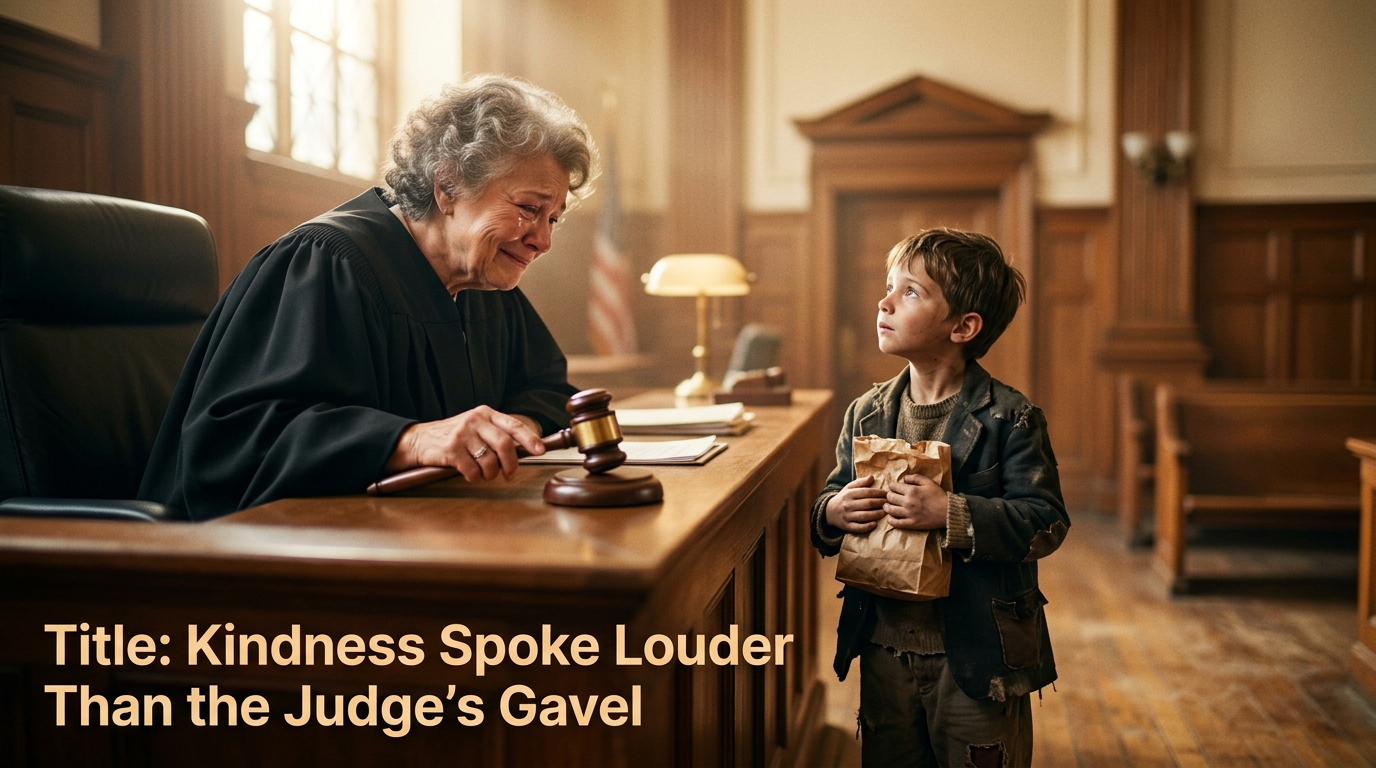
Kindness Spoke Louder Than the Judge’s Gavel
The Honorable Esther Vaughn had sentenced hundreds of people. She knew the weight of a gavel, the cold click of handcuffs, and the hollow echo of a courtroom door slamming shut. But in twenty years on the bench, she had never heard a case like that of eleven-year-old Elijah Carter.
Elijah stood before her, shoulders slumped, clutching a brown paper bag. His charge? Stealing a loaf of bread, a carton of milk, and a small jar of peanut butter from a corner market. The store owner, Mr. Hendricks, demanded the maximum penalty allowed for a minor: a five-hundred-dollar fine, thirty hours of community service, and a written apology.
“Your Honor,” the prosecutor began, “theft is theft. The law does not bend for hunger.”
Judge Vaughn looked down at Elijah. His sneakers were held together with duct tape. His jacket was two sizes too small. But his eyes—those eyes held no defiance. Only a deep, quiet shame.
“Elijah,” she said softly, “why didn’t you ask for help?”
He whispered, “I tried. My mama’s been sick. She lost her job. We didn’t eat yesterday. Or the day before. I didn’t know who to ask.”
The courtroom grew still. A bailiff shifted his weight. A clerk stopped typing. Mr. Hendricks crossed his arms, unmoved.
The law was clear. Judge Vaughn had the gavel in her hand. She could bang it, impose the sentence, and teach the boy a lesson about consequences. That would be justice.
But kindness, she had learned too late in life, is not the opposite of justice. It is justice’s highest form.
Instead of raising the gavel, she set it down.
“Mr. Hendricks,” she said, “you are owed restitution. And you will receive it. But I am adjourning this case for one week.”
Confusion rippled through the room.
The next morning, Judge Vaughn did something no one expected. She took off her robe, drove to Elijah’s apartment, and knocked on the door. His mother, pale and trembling with fever, answered. Behind her, the apartment was bare—no food in the cabinets, no heat, no blankets.
Esther Vaughn did not lecture. She did not call child services first. She went to the grocery store, bought two bags of food, and returned. Then she called a church friend who ran a free clinic. Then she called a social worker—not to punish, but to help.
One week later, Elijah stood before her again. But this time, the courtroom was full. Mr. Hendricks was there, still angry. So was the pastor from the church. So was a local journalist who had heard a rumor about the judge’s unusual actions.
Judge Vaughn spoke: “One week ago, I was ready to sentence this child for stealing food. But I asked myself: What is the court’s job? To punish poverty? To criminalize hunger?”
She turned to Mr. Hendricks. “Sir, you lost nine dollars in goods. But you have gained something greater: a community that sees you. I have arranged for the church to reimburse you double. And Elijah will write that apology.”
Then she looked at Elijah, and her voice broke—just for a second.
“But I am also ordering that Elijah be assigned to thirty hours of community service… serving meals at the same church that paid for the bread. Because he needs to learn not just the law, but dignity.”
She picked up her gavel. But instead of a sharp crack, she set it down gently.
“Case dismissed.”
Mr. Hendricks stood up. “But Your Honor—the law—”
“The law,” she interrupted, “is a floor. Kindness is a ceiling. And this court will always reach for the ceiling.”
The journalist wrote the story. It spread. People donated food, blankets, and winter coats to Elijah’s family. Mr. Hendricks, weeks later, dropped his opposition and started a “pay what you can” shelf in his store.
Elijah grew up. He became a youth counselor. And years later, when Judge Vaughn retired, she received a letter from him. It said:
“You taught me that justice without mercy is just revenge. Thank you for putting down the gavel and picking up my heart.”
Kindness spoke louder than the judge’s gavel. And it always will.




Leave a Reply