
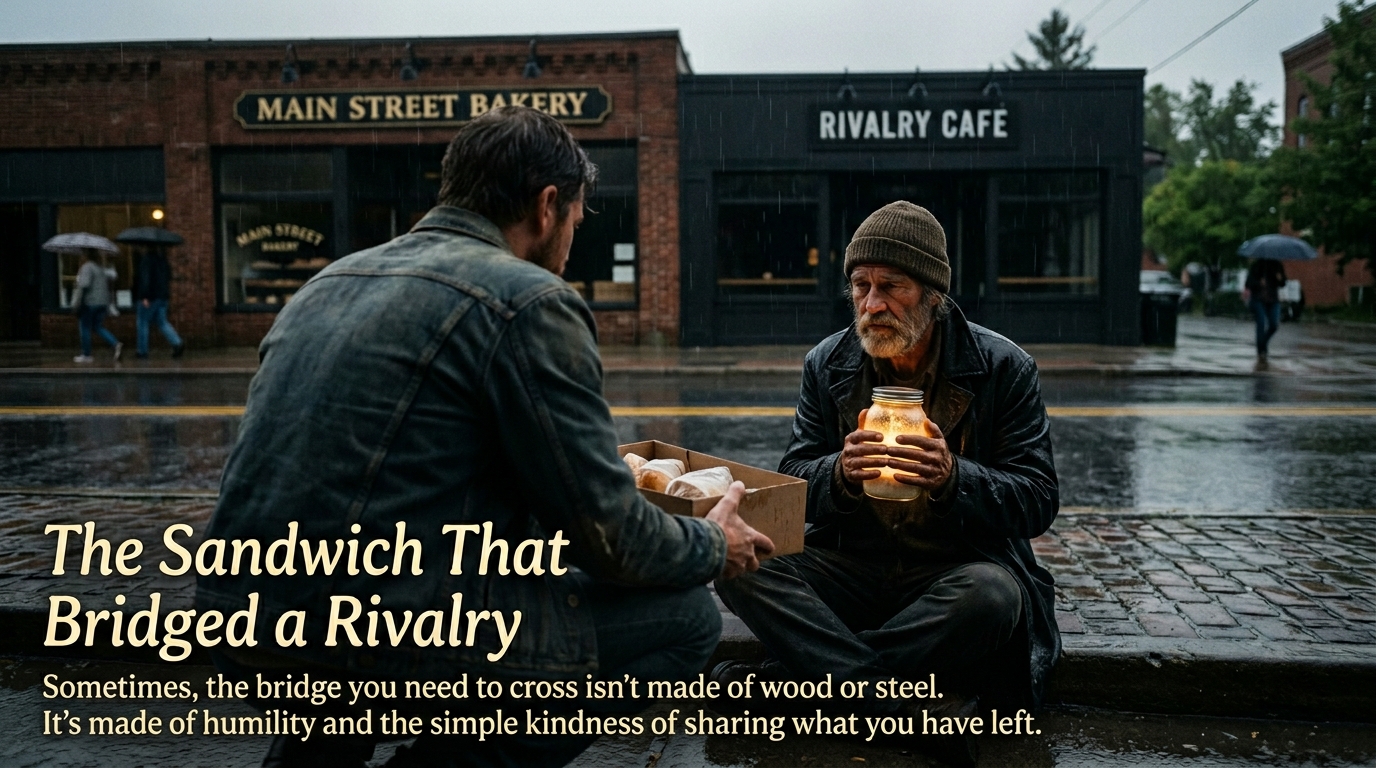
The rivalry between Elias Vane and Malcolm Reed was the kind of small-town legend that soured the air in the hardware store and dictated where you sat at the high school football games. It wasn’t about land or money; it was about bread.
Elias owned The Daily Rise, a bakery that had been in his family for seventy years. His sourdough starter, “Agnes,” was a century old. Malcolm opened The Grainery across the street three years ago, a sleek, modern patisserie with espresso machines that sounded like jet engines and croissants that shattered into a thousand buttery flakes.
For three years, they fought a silent, flour-dusted war. Elias would glare through his steamy window as customers lined up for Malcolm’s cold brew. Malcolm would roll his eyes as the scent of Elias’s ancient rye drifted into his minimalist shop. They were two kings of a very small, carbohydrate-based kingdom, and the border between them was the yellow line in the middle of Main Street.
Then came the storm of the century. The weatherman called it a “once-in-a-lifetime low-pressure system.” The town called it “The Big Wet.” The creek that normally babbled behind Main Street turned into a furious brown river. By 4:00 PM, the road was closed. By 4:15 PM, The Daily Rise’s basement—where Elias kept the industrial freezers and, more importantly, Agnes the starter—was flooding.
Elias was a proud, solitary man of sixty-eight with knuckles like walnuts. He stood ankle-deep in freezing water, holding a glass jar of bubbling goop to his chest. He had saved Agnes, but his entire week’s prep was destroyed. The power was out. The ovens were dead.
Across the street, Malcolm’s situation was the opposite. The Grainery sat on a slightly higher concrete pad. His basement was dry, but the power outage meant his fancy electric ovens were just expensive metal sculptures. Worse, his entire walk-in fridge of pre-made sandwiches and salads was slowly warming to the temperature of a dangerous petri dish.
As the sky turned purple with the next wave of rain, Malcolm looked out his window. He saw Elias sitting on the curb in front of The Daily Rise, soaking wet, holding a jar. He looked smaller than usual. Defeated.
For three years, Malcolm had wanted to beat Elias. He had fantasized about Elias admitting Malcolm’s baguette was superior. He had never fantasized about Elias being broken.
Swallowing his pride like a tough crust of bread, Malcolm grabbed a cardboard box. He filled it with the last of the ice from his non-functioning ice machine and then piled in the rapidly warming sandwiches: Turkey and Swiss on Ciabatta, Roast Beef on Brioche. Food that would be trash in an hour was now a fortune.
He jogged across the empty, rain-slicked street. Elias looked up, water dripping from his nose, his eyes narrowing in suspicion.
“Here,” Malcolm said, setting the box down with a splash. “Fridge is out. Can’t sell these. Don’t want to waste them.”
Elias stared at the sandwiches. Sandwiches made on Malcolm’s bread. Bread that had, in Elias’s private opinion, the wrong crumb structure.
“I don’t take charity,” Elias grumbled, his voice rough as sandpaper.
“It’s not charity. It’s a salvage operation,” Malcolm said, shivering now. “That jar you’re holding… that’s the mother dough, right?”
Elias nodded, clutching Agnes tighter.
“Without power, that thing will starve if you don’t keep it at least cool,” Malcolm pointed out, his scientific baker’s brain taking over. “My basement is fifty-five degrees and dry. I’ve got a stone floor.”
Elias looked from the precious jar in his arms to the sandwiches on the curb, then up at Malcolm’s face. He was looking for the smirk, the gloating “I told you so.” He didn’t find it. He only found a man who was cold, wet, and oddly concerned about a jar of fermented flour and water.
“You want me to keep Agnes… in your shop?” Elias asked, the absurdity of it all hitting him.
“The bread is more important than my ego,” Malcolm said, and he was surprised to find he meant it. “Probably more important than yours, too.”
That was the crack in the dam. Elias let out a sound that was half a groan, half a laugh. He stood up. He reached into the box and pulled out a Turkey and Swiss on Ciabatta. He took a bite. The bread was soft, the mayo tangy. It was good. Annoyingly good.
“Come on then,” Elias said, still chewing. “Let’s get her inside before she drops too many degrees.”
For the next two days, with the town dark and the roads closed, the two rivals lived in The Grainery by candlelight. They ate the thawing sandwiches and, more importantly, they talked. Malcolm marveled at the story of Agnes, who had traveled over the mountains with Elias’s great-grandmother. Elias, in turn, admitted he’d been eyeing Malcolm’s croissant technique with jealous fascination.
On the second morning, Elias took a cup of room-temperature starter from Agnes and mixed it with some of Malcolm’s high-end Italian flour. He made a simple flatbread in a cast-iron pan over a butane camping stove.
He handed half to Malcolm.
“See?” Elias said. “She’s particular about hydration, but she’ll adapt if you treat her kind.”
Malcolm took a bite. It was tangy, chewy, and alive. It tasted like history. It was, he had to admit, better than his own sourdough.
When the power finally blinked back on and the town thawed, something had shifted. The customers came back, expecting the usual frosty glare between the two shops.
Instead, they found a chalkboard sign propped in the middle of the street, bridging the yellow line.
It read: “Today’s Special: The Bridge Sandwich. Served at The Daily Rise (Bread by Elias). Served at The Grainery (Smoked Meat by Malcolm). Proceeds to Flood Relief.”
The line of customers snaked out of both doors and met in the middle, laughing and sharing bites. The rivalry hadn’t ended because one man was better than the other. It ended because a cold sandwich and a warm jar of sourdough proved that even the crustiest hearts have a soft side worth finding.

Leave a Reply