
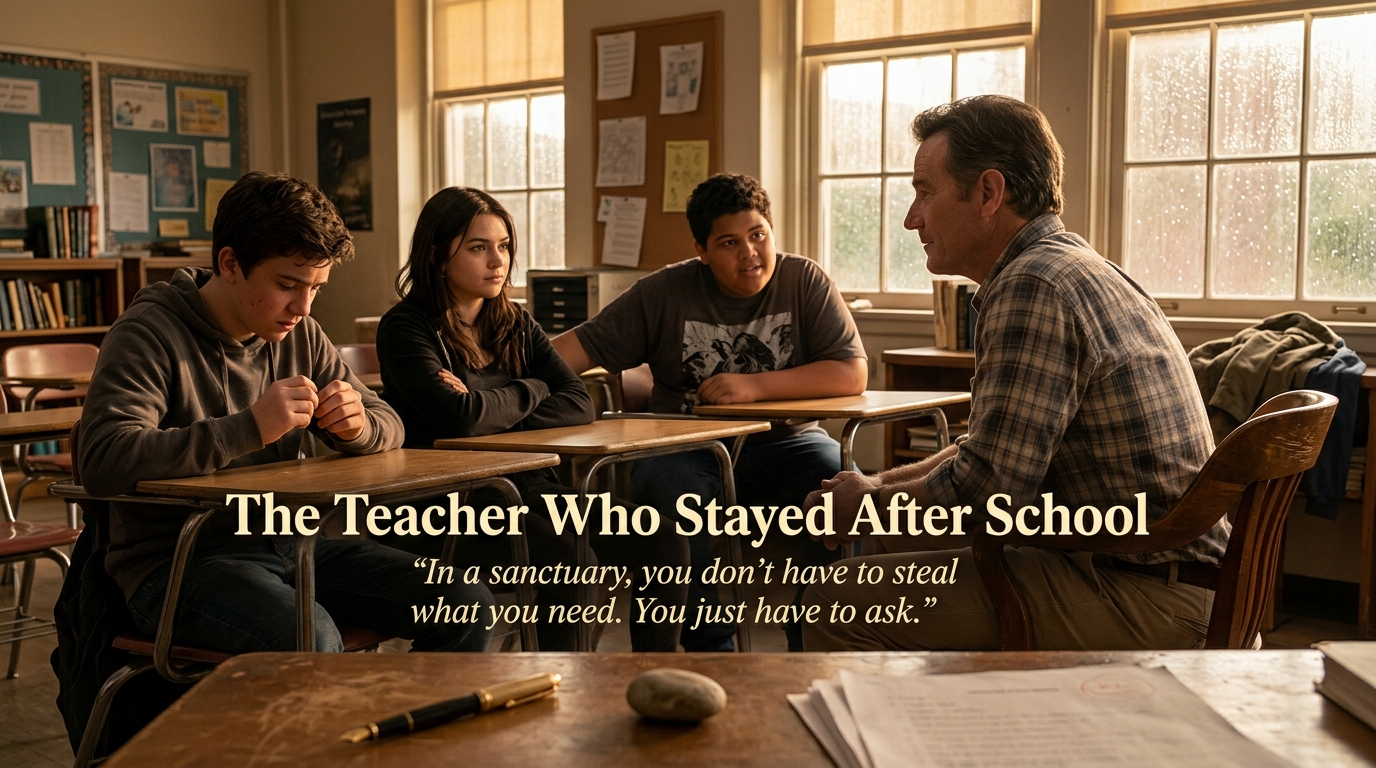
Leo Marchetti was the kind of teacher students called “Mr. Mar-cheese” behind his back. Not because he was funny, but because they thought he was soft. He taught eighth-grade history, but he spent more time teaching students how to sit with a heavy silence than he did drilling dates of battles. He was the teacher who never raised his voice, the one who stayed in his classroom until the janitor flicked the lights at 5:30 PM every single day.
To the outside world, Leo was a man who just didn’t like going home to an empty apartment. But to a handful of kids who had nowhere else to be, he was the hinge upon which their futures swung.
There were three of them who regularly stayed behind.
First was Cora. She was sharp as a tack but had a chip on her shoulder the size of a textbook. She stayed because her mom worked a double shift at the diner, and if she went home, she’d have to watch her younger brother while trying to drown out the sound of the broken radiator. Cora never said please or thank you. She’d just drop her bag on a desk and mutter, “Don’t talk to me.”
Second was Elijah. He was a giant of a boy, quiet and clumsy, with fists that accidentally broke pencils and a heart that bruised far too easily. He stayed because the school bus was a gauntlet of cruelty. In Mr. Marchetti’s room, he could sit in the back and carefully draw birds in the margins of his notebook without someone calling him “Lurch.”
Third was Sam. Sam was new. He didn’t stay to hide or to work; he stayed to steal. His family had moved to the district mid-year after being evicted from their last place. Sam’s clothes were a size too small, and his stomach growled so loud during silent reading that Elijah would instinctively slide his own uneaten granola bar across the aisle.
One rainy Tuesday in November, Mr. Marchetti noticed his grandmother’s fountain pen—a Waterman with a worn gold nib—was missing from his desk drawer. It was the only thing of value he owned, a gift from the woman who taught him that teaching was just a form of loving people long enough for them to learn.
The next afternoon, as the final bell rang and the halls emptied, Leo stood by the window, watching the rain streak the glass. He didn’t confront Sam. He didn’t check bags. He just turned from the window, smiled his gentle smile, and said, “Since it’s pouring, how about we stay a bit longer and I tell you a story?”
Cora rolled her eyes. “Is it about the Stamp Act again?”
“No,” Leo said, pulling up a squeaky chair and sitting backward in it. “It’s about a boy who had nothing.”
Sam, who had been fidgeting with his too-short sleeve, went very still.
Leo began. He told them about a kid who lived in a walk-up apartment in a city where the water tasted like rust. He told them about how this boy’s Nonna would make soup out of seemingly nothing—a bone, an onion, water. He told them how the boy, in his hunger and his shame, once stole a beautiful, shiny apple from the corner grocer, and how his Nonna saw the bulge in his pocket.
He paused. Elijah had stopped drawing. Cora had stopped pretending not to listen.
“Did she yell at him?” Cora asked, surprising herself.
“No,” Leo said, looking directly at the rain. “She didn’t say a word about the apple. Instead, she took his hand, walked him back to the grocer, and said, ‘My grandson made a mistake because his belly is bigger than his pride. We have no money, but I will sweep your floor until the debt is paid.’ And she did. Every morning for a week. She swept that floor with more dignity than a queen walking a palace hall. She taught the boy that you can be poor in your pockets but rich in your spine. That pen in my drawer was her pen.”
The room was so quiet you could hear the radiator hiss. Sam’s face was pale, his hands shoved deep into the pockets of his hoodie.
Leo stood up. “I was that boy,” he said simply. “And that apple was the best, and the hardest, meal I ever paid for.”
He walked to his desk and opened the drawer where the pen used to be. “Funny thing about that pen. It’s gone now. I think I must have left it on the ledge of the window. Maybe it fell. Maybe the wind blew it away. Or maybe, just maybe, it went to someone who needed to learn the same lesson about dignity that I learned.”
Leo looked at the three of them—one angry, one lonely, and one terrified. “I’m not staying late to supervise you. I’m staying late because this room is a sanctuary. And in a sanctuary, you don’t have to steal what you need. You just have to ask.”
The next morning, Leo Marchetti walked into his classroom before first period. The rain had stopped. On his desk, right in the center of the blotter, lay the Waterman fountain pen. Next to it was a crumpled, greasy dollar bill and a small, smooth stone Elijah had once shown him from the creek bed.
Cora was the first to arrive, early for once. She saw the items on the desk and looked at Mr. Marchetti, who was just sipping his coffee.
Without a word, Cora walked to her desk, sat down, and for the first time all year, she said, “Good morning, Mr. Marchetti. I… I actually finished the reading last night.”
Leo smiled and capped his pen. The debt had been swept clean. Class could begin.




Leave a Reply