
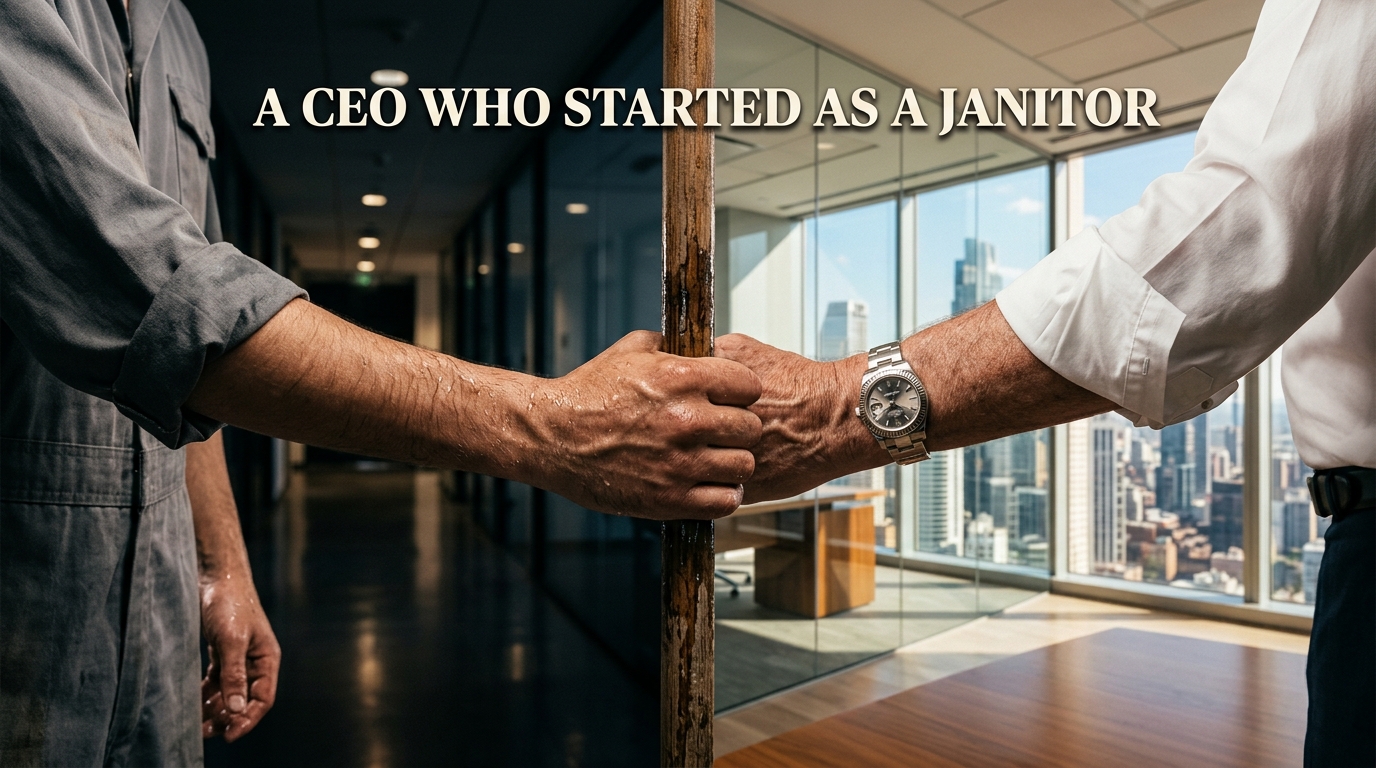
He hadn’t touched a mop in twenty-three years, but Arthur P. Calloway still remembered the exact weight of a wet industrial bucket.
The memory hit him hardest on the fifth floor of Calloway Tower. It was 6:15 a.m., and the building was a cathedral of silence. Arthur, now sixty-one with silver at his temples and a suit that cost more than his first car, stood in a corner office looking down at the sleeping city. But his eyes weren’t on the skyline. They were on the marble floor near the baseboard, where a single coffee ring had been left by last night’s cleaning crew.
He didn’t call maintenance.
Arthur walked to the utility closet on the third floor. He knew exactly where it was; he had helped design the building’s flow years ago, but the closet’s location? That was muscle memory from a different life.
Arthur had been eighteen when his mother got the diagnosis. His father had already been gone a decade, leaving a ghost and a stack of unpaid medical bills. College wasn’t just a dream deferred; it was a language spoken on a planet he couldn’t afford a ticket to. The only job he could get that paid enough for his mother’s morphine was the night shift at the Whitfield Financial building.
He was the janitor.
He wore a gray jumpsuit with “Art” stitched in red thread over the pocket. His job was to make the building sparkle for people who would never know his name. He emptied wastebaskets where traders tossed crumpled up dreams of fast money. He scrubbed toilets used by executives who looked right through him as if he were part of the plumbing.
He could have grown bitter. The soil was fertile for it. He was smart—painfully smart. He’d read the discarded financial pages from the trash and understand the complex merger jargon better than the interns who threw them away. But instead of resentment, Arthur planted something else in that soil: humility.
He had a motto, whispered to himself over the hum of the floor buffer: “Be the man who leaves the room cleaner than he found it—even if no one is watching.”
One night, around 2:00 a.m., he was polishing the brass railing near the CEO’s suite when he saw a light on. Mr. Whitfield, the founder of the firm, was slumped over his desk, tie loose, face gray with exhaustion and what looked like a ledger full of red ink. The old man was crying.
Arthur didn’t announce himself. He simply went back to his cart, made a cup of chamomile tea from his own small stash (he kept it for the security guard with insomnia), and placed it quietly on the corner of Mr. Whitfield’s desk. Beside the cup, he placed a single, perfect white gardenia he’d clipped from the planter in the lobby. Then he went back to buffing the floor.
The next morning, the tea was gone, but the gardenia was in a water glass on the credenza.
This silent ritual continued for months. Arthur never spoke unless spoken to. He just noticed things. He noticed when Mr. Whitfield’s shoulder slumped lower. He noticed when the wastebasket was full of shredded documents labeled “Foreclosure Threat.” And every night, he’d leave a small kindness: a sharpened pencil, a piece of hard candy, a perfectly aligned desk blotter.
Then came the night of the audit. Three men in expensive coats were combing through the office, yelling about a missing deed of trust—a document worth the entire company’s solvency. Arthur was emptying shredder bins when a scrap of paper snagged on his sleeve. It was a yellow sticky note with a signature and a series of numbers.
“Excuse me, sirs,” Arthur said, his voice rough from disuse in the silence of the night. “Is this what you’re looking for?”
The room froze. The man with the cruelest eyes snatched the note. “Where did you get this?”
“Shredder bin. Mr. Whitfield accidentally swept it off his desk yesterday with the junk mail. I… I empty the bins slowly, sir. I check for paperclips that might jam the machine.”
The document saved the company. Mr. Whitfield was so grateful he offered Arthur a “real job” the next day—a clerk’s position in the mailroom with a small pay bump.
Most people would have grabbed it as a ticket out. Arthur hesitated.
“Mr. Whitfield,” he said, standing in the opulent office still smelling faintly of his own floor wax. “I’m honored. But if I go to the mailroom, who’s going to make sure the grout in the executive washroom stays white? That’s where the board members judge the health of the company, sir. You can’t see it from the corner office, but I can. Let me keep my mop. Just pay me enough to get my mother the good medicine, and I’ll take care of the foundation of this place.”
Whitfield was stunned by the man’s integrity. He didn’t want a title; he wanted to do the job right.
Arthur didn’t become CEO overnight. He spent seven years on the night crew. During the day, he used the company’s tuition reimbursement program (a benefit he had to point out to HR that they offered) to take one class a semester. It took him twelve years to get a degree in finance. He moved from janitor to building supervisor, then to an analyst—a man who saw the “dirt” in the spreadsheets just as clearly as he saw dirt on the floor.
He rose because he never lost the janitor’s eye. He could walk into a branch office and know it was failing not by looking at the P&L statement first, but by looking at the baseboards. If the baseboards were dirty, it meant the manager didn’t care about the details nobody sees. And a man who ignores what nobody sees is a man who will eventually steal from the company or lose the client.
When Mr. Whitfield passed away, childless and weary, his will contained a shock. He left the controlling share of Whitfield Financial to Arthur Calloway.
The note attached to the will read: “To the only man in this building who ever brought me tea without wanting a favor in return. He built the foundation while I was busy worrying about the roof. Give him the keys.”
Back in the present, Arthur unbuttoned the cuffs of his $4,000 Brioni shirt. He rolled them up to the elbow. He filled the mop bucket with hot water and the same industrial pine cleaner he’d used forty years ago. He walked back to the fifth-floor corner office, the one with his name on the door.
He got down on one knee and scrubbed the coffee ring off the marble floor.
His new assistant found him there, wringing out a rag.
“Mr. Calloway! What are you doing? I can call facilities!”
Arthur looked up, his knees aching and his heart full.
“No, Sarah. You don’t call facilities. I’m facilities.” He smiled, the kind of smile that comes from a man who knows his own worth. “Never forget where the floor meets the wall. That’s where the building either stands or rots. And never be too important to scrub a stain yourself.”


Leave a Reply