
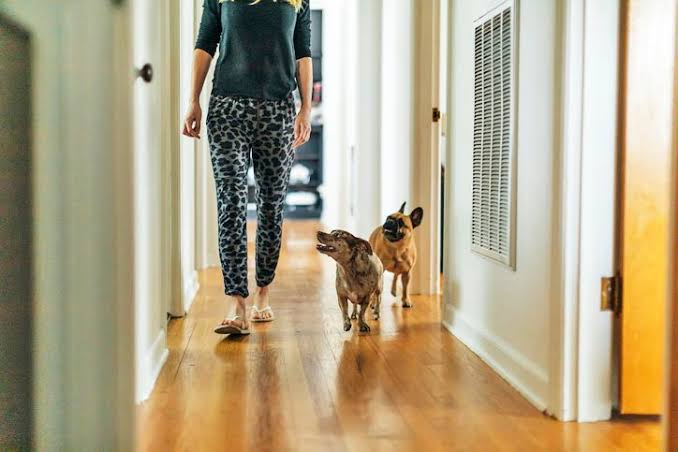
Why Does My Dog Follow Me Everywhere? What “Velcro Dog” Behavior Really Means
Does your dog follow you from room to room like a little shadow?
You get up from the couch, and your dog gets up too. You walk into the kitchen, and those paws follow. Even a quick trip to the bathroom can turn into a full family outing.
So, why does my dog follow me everywhere?
In many cases, it’s completely normal. Dogs are social animals, and some simply enjoy staying close to their favorite person. Others may follow because they have learned that being near you leads to attention, treats, walks, play, or other rewarding experiences.
But there is an important difference between a dog that likes being near you and a dog that becomes distressed when you are away.
Let’s look at what your dog’s behavior may actually mean.
What Is a “Velcro Dog”?
“Velcro dog” is an informal term for a dog that strongly prefers staying close to their person. It isn’t a medical diagnosis.
A Velcro dog may:
- Follow you from room to room
- Sit or sleep close to you
- Wait outside the bathroom
- Get up whenever you get up
- Seek frequent attention
- Watch what you’re doing around the house
Some dogs are naturally more people-oriented than others. Following you does not automatically mean your dog has anxiety.
The more important question is:
What happens when your dog can’t follow you?
Why Does My Dog Follow Me Everywhere?
There isn’t one single reason. Your dog’s personality, routine, environment, and past experiences can all play a role.
1. Your Dog Enjoys Your Company
Some dogs simply like being around their humans.
If your dog follows you but can also relax, sleep, eat, play, and settle comfortably when you’re busy, following you may simply be part of their personality.
Some dogs are independent.
Others want to be wherever their favorite person happens to be.
2. Following You Gets Your Dog Attention
Dogs quickly learn patterns.
If following you often results in petting, praise, treats, play, or conversation, your dog may learn that staying close is rewarding.
It’s not necessarily a problem. Your dog may simply have learned:
“Good things happen when I stay near my person.”
3. Your Dog Knows Your Routine
Dogs are excellent at recognizing household routines.
You grab your keys, and your dog expects a walk.
You walk toward the kitchen, and your dog expects food.
You put on certain shoes, and your dog may know that you’re about to leave.
Your dog may follow you because they have learned that your movements often predict something interesting.
4. Your Dog Is Bored
Sometimes you’re simply the most interesting thing happening in the house.
A dog that doesn’t get enough appropriate exercise, play, training, or mental stimulation may follow their owner because there isn’t much else to do.
Providing appropriate enrichment and opportunities for independent activities can help.
5. Your Dog Feels Safer Near You
Some dogs seek out their trusted person when they’re nervous.
You may notice more following during thunderstorms, fireworks, unfamiliar situations, changes in the home, or other stressful events.
In these situations, the important thing is to look at the whole behavior, rather than assuming that following automatically means separation anxiety.
6. Your Dog Is Naturally Clingy
Some dogs simply have a more people-focused personality.
Individual temperament matters, even among dogs of the same breed.
One dog may happily sleep in another room.
Another may follow their owner everywhere.
Neither behavior is automatically abnormal.
7. The Behavior Is New
This is one situation worth paying closer attention to.
If your dog has always followed you, it may simply be their normal behavior.
But if your dog suddenly becomes much more clingy, especially if other changes appear at the same time, it is worth talking with your veterinarian.
A sudden behavior change can sometimes be associated with stress, aging, discomfort, or an underlying health issue.
Velcro Dog vs. Separation Anxiety
This is where many dog owners get confused.
Following you everywhere does not automatically mean your dog has separation anxiety.
A Velcro dog may follow you around the house but remain perfectly comfortable when you leave.
A dog experiencing separation-related distress may become significantly anxious when separated from their person.
A dog that is simply very attached may:
- Follow you around the house
- Prefer to sit near you
- Seek attention
- Relax when you are busy
- Sleep or rest independently
- Remain calm when you leave
A dog with separation-related distress may show:
- Excessive barking or whining when left alone
- Pacing or restlessness
- Destructive behavior
- Attempts to escape
- House-soiling during separation
- Signs of significant distress when the owner leaves
So don’t judge the situation only by how closely your dog follows you.
Pay attention to what happens when you are not there.
Why Does My Dog Follow Me to the Bathroom?
If your dog already follows you everywhere, the bathroom may simply be another destination.
Your dog may also have learned that following you can lead to attention or interaction.
So while it may feel like your dog is determined to supervise every private moment, the behavior may simply be part of their normal attachment and routine.
If your dog is otherwise relaxed and comfortable alone, following you into the bathroom isn’t necessarily a concern.
And if you want a deeper look at this specific behavior, see our related article:
[Why Does My Dog Follow Me to the Bathroom? The Truth About “Velcro Dogs”]
Internal link: Link this text to Article #1 once the Article #1 URL is confirmed in WordPress.
Why Does My Dog Follow Me but Not My Partner?
This can happen in multi-person households.
Your dog may have developed a stronger association with one person because that person:
- Feeds them
- Walks them
- Plays with them
- Gives treats
- Spends more time with them
- Handles more of their daily routine
That doesn’t necessarily mean your dog dislikes your partner.
Your dog may simply have learned that one particular person is especially important in their daily life.
How Can I Help My Dog Become More Independent?
If your dog is healthy and isn’t showing signs of separation-related distress, you can gradually encourage independent behavior.
Reward Calm, Independent Behavior
Notice when your dog settles quietly on their own.
For example, if your dog relaxes on their bed while you’re working, calmly reward that behavior when appropriate.
This teaches your dog that being relaxed away from you can also be rewarding.
Create a Comfortable Resting Area
Give your dog a comfortable place to relax with an appropriate bed and safe toys.
You’re not trying to push your dog away.
You’re giving them another place where they can feel comfortable.
Provide Mental Stimulation
Age-appropriate play, training, sniffing activities, interactive toys, and food puzzles can give your dog something productive to focus on.
Let Other Family Members Participate
If one person handles nearly everything, the dog may naturally become especially focused on that person.
Letting other trusted family members participate in feeding, walking, play, and training can help create positive relationships throughout the household.
Teach Your Dog to Settle
You can gradually teach your dog to relax on a bed or mat while you remain nearby.
Start with short periods and build gradually.
If your dog shows serious distress when separated from you, don’t try to force independence. Professional guidance may be more appropriate.
When Should You Talk to a Veterinarian?
Talk with your veterinarian if your dog’s clinginess:
- Appears suddenly
- Becomes dramatically stronger
- Happens alongside other behavior changes
- Appears in an older dog
- Occurs with signs of illness or discomfort
- Includes severe distress when you leave
A veterinarian can help determine whether a health problem or another factor could be contributing to the behavior.
If separation-related distress is suspected, your veterinarian can also help guide you toward appropriate behavioral support.
The Bottom Line
So, why does your dog follow you everywhere?
There isn’t one universal answer.
Your dog may simply enjoy your company. They may have learned that following you leads to attention or rewards. They may be curious, bored, naturally people-oriented, or looking for reassurance.
The most important clue is how your dog behaves when you aren’t available.
A dog that follows you around but can comfortably relax alone may simply be a devoted companion.
A dog that panics whenever you’re gone may need additional help.
And if the behavior suddenly changes, especially when other changes appear, it’s worth discussing with your veterinarian.
Your dog can enjoy being close to you and learn to feel comfortable when you’re not right beside them.
Frequently Asked Questions
Is it normal for my dog to follow me everywhere?
Yes. Many dogs naturally prefer staying close to their people. If your dog can also relax independently and remains comfortable when you’re away, following you around isn’t necessarily a problem.
Is a Velcro dog the same as a dog with separation anxiety?
No. A Velcro dog prefers staying close to their person, while separation-related distress involves significant distress when the person is absent.
Why does my dog suddenly follow me everywhere?
A sudden change can have several possible causes, including changes in routine, stress, aging, discomfort, or health problems. If the change is significant or happens with other symptoms, contact your veterinarian.
Why does my dog follow me to the bathroom?
If your dog already follows you throughout the house, the bathroom may simply be another place they want to go with you. It isn’t necessarily a sign of anxiety.
How can I stop my dog from following me everywhere?
If your dog is healthy and comfortable when alone, gradually encourage independent behavior by rewarding calm settling, providing enrichment, and teaching your dog to relax in their own space.


Leave a Reply